A crown hair transplant restores density to the vertex, a challenging area due to its circular growth pattern. At Hair Upload Clinic in Istanbul, Dr. Erkam plans each procedure by balancing aesthetic goals with donor limitations. We use local anaesthesia and precise Sapphire FUE techniques to achieve natural, lasting coverage.
Understanding Crown Hair Transplants: Definition and Purpose
A crown hair transplant, also known as a vertex hair transplant, is a surgical procedure designed to restore hair density to the balding area at the back of the head. This region, frequently referred to as the crown or vertex, is highly susceptible to male pattern baldness. It usually presents as a circular thinning patch that gradually expands over time. Unlike the frontal hairline, which is immediately noticeable, the crown often thins subtly. Sometimes, individuals do not notice the extent of the hair loss until it has become quite significant.
The primary purpose of a crown hair transplant is twofold. First, the surgeon must recreate the natural swirl, or whorl pattern, characteristic of hair growth in this specific region. Second, the procedure aims to achieve sufficient density so that the transplanted hair blends seamlessly with the surrounding native hair. Because the crown covers a large surface area that stretches as baldness progresses, restoring it requires a distinct clinical approach compared to the frontal hairline. Success relies on careful graft distribution and a deep understanding of how light interacts with hair at varying angles to create the illusion of true thickness.
At Hair Upload Clinic, our priority is delivering outcomes that are aesthetically pleasing and sustainable for the long term. We evaluate both the immediate cosmetic needs and the likelihood of future hair loss, ensuring we build a strategic plan for your crown restoration that preserves your donor reserve.
Indications and Candidacy for Crown Hair Restoration
Determining if you are a suitable candidate for a vertex hair transplant involves a thorough clinical evaluation. Ideal candidates typically exhibit stable hair loss. This means their balding has progressed to a stage where it is unlikely to worsen rapidly in the near future, or the loss is effectively managed with medical therapies. The Norwood scale is the standard metric used to classify male pattern baldness. Individuals presenting with Norwood patterns III Vertex, IV, V, VI, or VII are typically the ones considering surgical crown restoration.
Key Candidacy Factors
- Age and Stability: Younger patients under 30 with significant crown loss are often advised to wait or pursue medical management first. Because hair loss is progressive, operating too early might result in visible unnatural gaps if the surrounding native hair continues to recede.
- Donor Hair Supply: The quality and quantity of hair in your donor area, located at the back and sides of the head, dictate the surgical parameters. You need a robust donor supply to provide enough grafts for adequate coverage without over-harvesting, which could permanently thin the donor zone.
- Hair Characteristics: Hair shaft thickness, colour contrast, and texture play a massive role in your final result. Thicker, curlier hair provides excellent coverage and perceived density with fewer grafts. Conversely, fine, straight hair requires a higher graft count to achieve the same visual impact.
- Realistic Expectations: Understanding the limits of the procedure is vital. The crown encompasses a broad surface area. While excellent, natural-looking density is highly achievable, it may not perfectly match the dense, native thickness of the hair above your ears. We discuss these expectations openly during your consultation.
At HU Clinic in Istanbul, Dr. Erkam conducts each consultation personally. He assesses your unique hair loss pattern, donor capacity, and overall scalp health to determine the most appropriate treatment timeline. This individualised evaluation ensures your crown transplant is safely tailored to your specific case.
The Crown Hair Transplant Procedure: Steps and Techniques
The process of a crown hair transplant at Hair Upload Clinic follows a precise, surgeon-led methodology. We primarily utilise the Sapphire FUE (Follicular Unit Excision) technique. We reserve DHI (Direct Hair Implantation) for specific cases, particularly when we need higher density in smaller localized zones or for unshaven procedures. Both techniques rely on local anaesthesia to ensure a pain-free experience.
1. Consultation and Recipient Planning
Your procedure begins with detailed mapping by Dr. Erkam. Even if the primary focus is the crown, establishing a harmonious hairline design guide ensures the entire head looks balanced. Dr. Erkam assesses your donor area, calculates the exact graft count required, and determines the surgical boundaries. He then designs the natural whorl pattern, deciding the exact angle and direction each hair must follow to mimic your native growth.
2. Local Anaesthesia
Before the surgical phase begins, local anaesthesia is administered to both the donor and recipient areas. This keeps you comfortable and alert throughout the procedure. We do not use intravenous sedation or general anesthesia.
3. Graft Extraction
Under the direct supervision of Dr. Erkam, our expert surgical technicians carefully extract individual follicular units from the donor zone using specialised micro-punches. This minimally invasive FUE approach leaves no linear scar and allows for a quick recovery. The extracted grafts are immediately stored in a specialised holding solution at a controlled temperature to maintain their viability.
4. Channel Opening (Sapphire FUE)
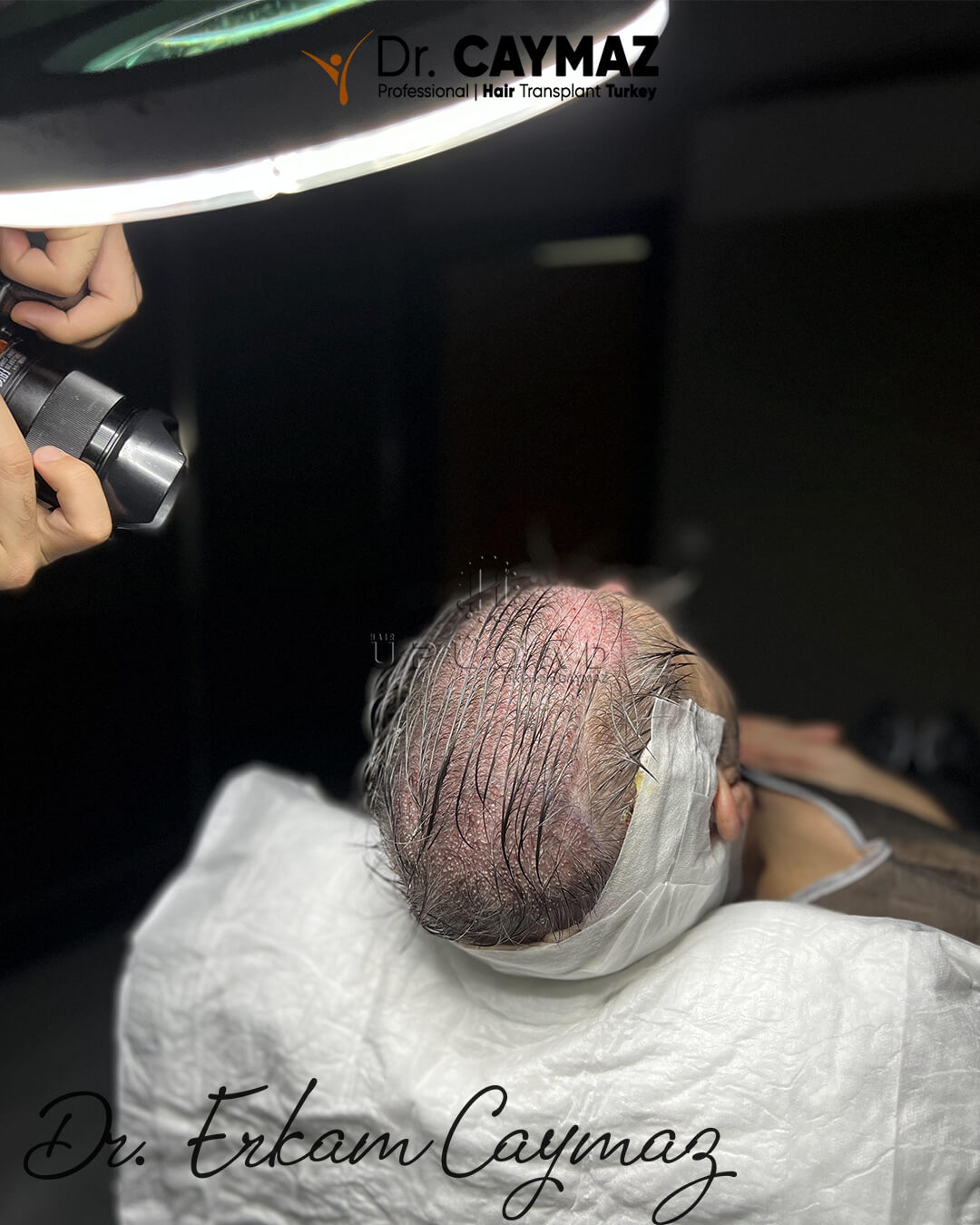
For Sapphire FUE procedures, Dr. Erkam personally creates the recipient sites in the balding crown using finely crafted sapphire blades. These specialized blades allow for exceptionally precise incisions, allowing him to dictate the exact depth, angle, and direction of each channel. This control is what makes the natural crown swirl possible. The sharpness of the sapphire blade also minimises tissue trauma and bleeding, relying on natural vasoconstriction and epinephrine rather than electrocautery.
5. Graft Implantation
Following the channel creation, our experienced surgical technicians delicately implant the prepared follicular units into the pre-made sites. Each graft is placed according to Dr. Erkam’s blueprint. For DHI cases, technicians use Choi implanter pens to load and place the grafts simultaneously, providing high control over the emergent angle without requiring separate incisions.
Our process is designed to be efficient and safe, maintaining a boutique standard of care. You can read our detailed FUE vs. DHI hair transplant comparison to better grasp these technical distinctions.
Key Comparison: Factors Influencing Crown Density Goals
Achieving optimal density in a crown hair transplant requires a delicate balance between patient expectations and clinical realities. Several distinct variables dictate the realistic density goals and the total number of grafts required. Understanding these elements helps formulate an accurate surgical plan.
| Clinical Factor | Impact on Crown Density Goals | Surgical Approach at HU Clinic |
|---|---|---|
| Donor Area Density | A high-density donor zone yields more available grafts. Limited donor reserves necessitate conservative coverage goals. | Microscopic evaluation by Dr. Erkam to map safe extraction limits without compromising donor integrity. |
| Hair Calibre (Thickness) | Thicker hair shafts deliver superior coverage and visual density using fewer grafts. Fine hair demands higher graft counts. | Strategic graft distribution designed to maximise the visual impact of your specific hair characteristics. |
| Colour and Texture Contrast | High contrast between hair and scalp tone lowers perceived density. Wavy or curly hair naturally offers better coverage than straight hair. | Density gradients are adjusted to minimise scalp visibility, enhancing natural blending and depth. |
| Balding Surface Area | Expanding crown baldness stretches the recipient zone. Spreading grafts over a massive area lowers the average density per square centimetre. | Focusing graft clusters toward the focal point of the whorl to create an illusion of complete coverage. |
Risks, Limitations, and the Post-Operative Timeline
Like any clinical intervention, a vertex hair transplant carries certain risks and limitations. Recognising these realities is essential for a smooth recovery. We maintain a boutique practice model at Hair Upload Clinic, focusing on strict safety protocols and comprehensive aftercare guidance to minimise complications and support high graft survival rates.
Potential Risks
- Shock Loss: A temporary shedding of existing native hair around the transplanted zone is common a few weeks after surgery. This is a natural physiological response to trauma, and the hair typically regrows. We provide extensive details on this phenomenon in our guide covering what is shock loss after hair transplant.
- Scarring: While FUE leaves only microscopic dot scars, extracting a massive number of grafts can give the donor area a slightly thin or moth-eaten appearance if not spaced correctly. Dr. Erkam prevents this by strictly monitoring extraction ratios.
- Graft Survival Rates: Not every single transplanted follicle will take root. While our clinic targets a graft survival rate of up to 98%, individual physiological factors can occasionally alter this outcome.
Recovery and Aftercare Timeline
The initial healing phase dictates the long-term success of your crown restoration. Adhering to our post-operative instructions protects your investment.
- Days 1 to 3: Mild swelling and redness are expected around the recipient and donor areas. You will sleep with your head elevated to minimise inflammation.
- Days 4 to 7: Scabbing will naturally begin to form around the transplanted grafts. You will begin gentle hair washing using the specific techniques and solutions provided by our clinical team.
- Weeks 2 to 3: Most of the redness fades, and the scabs naturally fall away. The transplanted hairs often shed during this phase, which is a normal part of the growth cycle.
- Months 3 to 6: The follicles exit their resting phase. You will notice new, fine hair beginning to pierce the scalp. Nerve regeneration may cause slight itching, indicating active healing.
- Months 9 to 12: The crown swirl takes shape as the hair thickens and matures. Final cosmetic density and texture usually stabilise around the one-year mark.
Managing Expectations: Graft Counts and Long-Term Density
Patients often ask for complete, dense coverage over a massive crown area using a minimal number of grafts. It is vital to understand that the crown is a three-dimensional canvas. The skin stretches and shifts as you move your neck. Distributing 2,000 grafts over the frontal third of the scalp yields dense results. Spreading those exact 2,000 grafts across a large, expanding vertex requires a masterful understanding of visual density.
To achieve a natural result, Dr. Erkam utilises a macro-irregular distribution pattern. He places higher-density clusters strategically toward the centre of the whorl, gradually feathering the grafts outward. This uses light and shadow to trick the eye. The hair appears full and thick, even if the actual graft-per-square-centimetre count is moderate. This technique preserves your finite donor supply, leaving enough grafts in reserve should your hair loss progress in the future.
Our overall success rate of 90–95% is evidence of this disciplined, patient-first methodology. We never promise unnatural, absolute 100% density because doing so would require over-harvesting your donor area, risking long-term damage. We provide honest, realistic hair restoration tailored to your lifetime needs.
Frequently Asked Questions (FAQ)
Does a crown hair transplant look natural?
Yes, a crown hair transplant looks entirely natural when performed by an experienced surgeon. The key to a realistic result lies in recreating the natural whorl pattern. Dr. Erkam maps the precise angle and direction of your native hair growth, ensuring the transplanted follicles blend flawlessly with the surrounding area.
How many grafts are needed for a crown hair transplant?
The number of grafts required depends entirely on the size of the balding area and your hair characteristics. A small crown spot might require 1,500 grafts, while a significantly expanded vertex could need 3,000 or more grafts to achieve adequate visual coverage. Dr. Erkam determines the exact count during your consultation.
Will the transplanted crown hair fall out again?
No, the transplanted hair is highly resistant to male pattern baldness. Extracted from the safe donor zone at the back of the head, these follicles retain their genetic resistance to DHT. Once they settle and begin growing in the crown, they will continue to grow permanently. However, your native hair surrounding the transplant may still thin over time.
Can I wear a hat after a crown hair transplant?
Yes, you can wear a loose-fitting hat immediately after your procedure to protect the sensitive grafts from dust, sun, and accidental bumping. Our clinical team will show you exactly how to place and remove the hat so you do not dislodge the newly implanted follicles during the first few days.
Disclaimer: This content is strictly for educational purposes and does not replace professional medical advice. A surgical consultation is required to determine candidacy and outline clinical risks based on your individual health profile.
Clinic insight: At Hair Upload Clinic, Dr. Erkam uses custom sapphire blades to dictate the exact angle of the crown whorl. This technical precision allows us to maximise visual density without depleting the donor area.
Frequently Asked Questions
How long is recovery for this topic: Crown hair transplant: density goals and realistic coverage?
Most patients return to desk work within a few days, but graft protection rules apply for the first 10–14 days.
Is local anaesthesia used at Hair Upload Clinic?
Yes. Procedures are performed under local anaesthesia; sedation is not promoted for routine hair transplant surgery.
Can Dr. Erkam assess my case before I travel?
Yes. International patients can share photos and medical history for a preliminary graft estimate before booking Istanbul dates.
What affects graft survival after surgery?
Donor quality, implant technique, aftercare, smoking, and following the clinic wash protocol all influence early graft retention.
- American Academy of Dermatology (AAD): Hair transplants overview
- PubMed: Follicular Unit Excision (FUE) surgical standards
- International Society of Hair Restoration Surgery (ISHRS): Restoring the crown region
Medical disclaimer: This page is for education only and does not replace a consultation with Dr. Erkam at Hair Upload Clinic (HUC). Individual assessment is required.
Written by : Dr. Erkam C.