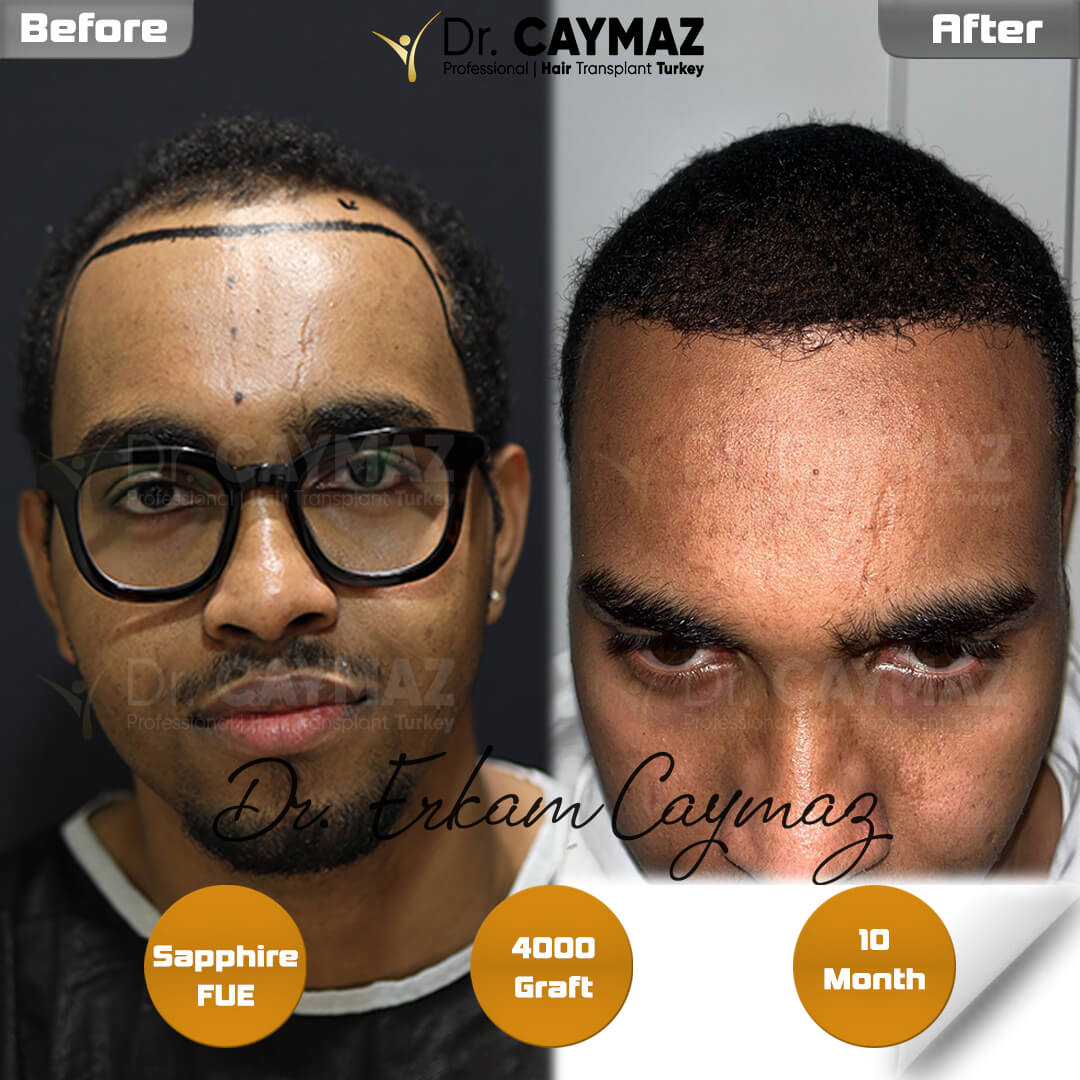
Hairline design for men means matching the hairline’s shape, height and graft density to your age, hair calibre and future loss pattern. At Hair Upload Clinic in Istanbul, Dr. Erkam plans each male hairline surgeon-led, so the result still looks natural decades later.
What is hairline design for men?
Hairline design is the surgical planning step that decides where your new hairline sits, what shape it follows, and how grafts are distributed across it. For men, the goal is a line that looks like it belongs to your face now and still belongs to it in twenty years. That means the design has to respect three things at once: your facial proportions, your age, and the pattern your hair loss will follow in the future.
A hair transplant is not reversible in the way a haircut is. Grafts placed too low, or in a shape that’s too flat and youthful for a man in his fifties, create a result that reads as artificial the moment surrounding hair thins further. This is why planning matters more than technique in frontal work. If you’d like the broader picture covering both sexes, our hairline design guide covers the full planning framework; this article stays focused on men.
Who needs age-appropriate hairline planning?
Most men who come to Hair Upload Clinic Istanbul for consultation fall into one of three groups. The first group has frontal recession, a receding corners pattern where the temples retreat and a widow’s peak remains. The second group has diffuse thinning across the front third of the scalp, where the existing hairline is still visible but density has dropped. The third group has already lost the frontal zone completely and needs a full hairline reconstruction from scratch. Many international patients review Sapphire FUE while planning their trip.
Candidacy depends on more than the visible gap. Dr. Erkam assesses donor area quality, hair shaft calibre, scalp laxity, and the likelihood of future loss using magnified examination. Men in their early twenties with aggressive, fast-moving loss are usually advised to stabilise with medication first and wait, because building a hairline on a moving frontier almost always needs a second surgery later. Men with stable loss, realistic expectations, and a donor area that can support both the current plan and future top-ups are good candidates. For clinic-specific context, see DHI implantation.
There’s no single correct age for a transplant, but there is a correct design for each age. A 28-year-old and a 55-year-old with identical recession should not receive identical hairlines.
How a male hairline is designed: step by step
At HU Clinic, the design process follows a fixed clinical sequence. Here’s what happens, in order.
- Facial measurement. The surgeon measures the distance from the glabella (the bump between your eyebrows) to the current hairline position, then relates it to forehead width and facial thirds. Most adult male hairlines sit between 7 and 9 cm above the glabella, depending on face shape.
- Age-adjusted position. The planned line is placed higher for older patients and slightly lower, within safe limits, for younger ones. A conservative position preserves donor grafts for future loss and avoids a juvenile look later.
- Shape selection. Men need a gentle, irregular curve with slight temporal recession. A perfectly symmetrical, rounded line looks feminine or artificial on a male face. The design keeps natural asymmetry, often a few millimetres of difference between the two sides, because your face was never perfectly symmetrical to begin with.
- Zoning and irregularity. The hairline isn’t one line but three zones: a transition zone of single-hair grafts at the very front, a defined zone behind it, and the frontal core where density is concentrated.
- Graft distribution planning. Finer single-hair follicular units go in the front 2–3 mm; two and three-hair grafts sit behind them to build visual density where it counts.
Once the design is drawn, the surgery itself follows standard FUE principles. With Sapphire FUE, the technique we use as default, Dr. Erkam opens the recipient channels with a sapphire blade, which allows precise control of angle and direction. Angle is critical at the hairline: grafts must exit the skin at roughly 20–35 degrees, pointing forward, or the hair will stand up like brush bristles regardless of how well the line itself was drawn.
Age-appropriate shape and density: the reference table
The table below summarises how design targets shift with age. These are planning ranges, not fixed rules, and every case gets individual assessment.
| Age band | Typical hairline shape | Frontal zone graft focus | Density target (grafts/cm²) |
|---|---|---|---|
| 25–34 | Slightly rounded with defined temporal recessions | Single-hair transition zone, conservative height | 45–55 |
| 35–44 | Soft M-shape or gentle bell curve | Mixed single and double grafts, mid-position line | 40–50 |
| 45–54 | Flatter, higher line with recession built in | Doubles concentrated behind transition zone | 35–45 |
| 55+ | Mature line, often temple-only reinforcement | Selective density over the frontal core | 30–40 |
Notice the pattern: as age rises, the line goes higher and the density target drops. That’s not stinginess, it’s realism. Older scalps often have finer donor hair, reduced blood supply in the recipient area, and a larger total area to cover. Concentrating fewer grafts where they’re visible produces a better aesthetic result than spreading thin density everywhere.
Graft distribution: where the grafts actually go
Graft distribution is what separates a natural hairline from a dense wall of hair. A well-designed male hairline uses roughly 30–40% of the session’s grafts in the first 1.5 cm and behind the drawn line, with the remaining grafts layered into the mid-scalp transition so the new hairline blends with existing hair rather than stopping abruptly.
Distribution also has to account for contrast. If your donor hair is coarse and dark against a pale scalp, each graft casts more visual weight, so fewer grafts per cm² are needed for the same perceived density. Fine, light-coloured hair needs higher graft numbers to achieve the same look. This is why two patients with identical hairline plans may receive different total graft counts, sometimes 1,800 versus 2,400 grafts for the same area.
For men who don’t want to shave the existing frontal hair, DHI implantation with Choi pens allows placement between native hairs. We use DHI selectively for these cases at Hair Upload; for most frontal reconstructions, Sapphire FUE gives excellent angle control and faster healing. Neither technique is universally better, the deciding factors are case-specific, and Dr. Erkam generally prefers Sapphire FUE for frontal hairline work.
Risks, limits and aftercare timeline
Hairline surgery carries the same general risks as any FUE procedure: swelling in the forehead for two to four days, temporary shock loss of native hair near the transplanted zone, and a small risk of ingrown hairs or folliculitis during healing. Graft survival rates of up to 98% are achievable when handling protocols are tight, and overall success across well-selected cases sits in the 90–95% range. No honest clinic can promise a guaranteed outcome for every patient.
The specific design risks are aesthetic: a hairline placed too low, a shape too rounded for a male face, or density concentrated in one zone so the line looks striped. These are planning failures, not technique failures, which is why the design stage deis much scrutiny as the surgery itself.
Here’s a typical healing timeline for the frontal zone:
- Days 1–3: Scabbing at recipient sites; first medicated wash at the clinic.
- Days 4–10: Swelling resolves; scabs begin to clear with daily washing.
- Weeks 2–6: Transplanted hairs shed, which is normal and expected.
- Months 2–4: Shock-lost native hair returns; new growth starts.
- Months 6–9: Visible density build; texture may initially be wiry.
- Month 12: Final assessment of hairline shape and density.
Aftercare is straightforward: sleep semi-upright for the first week, avoid direct sun on the forehead for a month, and hold off on heavy exercise for ten to fourteen days. For patients travelling home from Istanbul, we schedule the first wash before departure and provide written follow-up instructions plus video review access.
What international patients should know about planning
If you’re travelling to Istanbul for a hairline procedure, expect the planning consultation to happen before anything else. At HU Clinic, Dr. Erkam personally handles consultation, hairline design and channel opening for every case; the clinic performs one to two VIP operations per day, so planning is never rushed through a template. Graft extraction and implantation are carried out by expert surgical technicians under his direct supervision.
Send clear photos in advance if you can: front, both temples, top and donor area, in even lighting. This lets the team estimate graft numbers before you fly. Hairline-focused cases typically need between 1,200 and 2,500 grafts depending on recession depth and density goals, with graft pricing in Istanbul generally running 2–4 Euro per graft.
One practical note: bring photos of yourself from your twenties if you liked that hairline, but expect the surgeon to moderate it. The hairline you had at 19 is rarely the right target at 40, and a good surgeon will tell you so. Medication decisions, finasteride or minoxidil for stabilising loss behind the new line, are made case by case with your physician, since they carry individual risks and benefits.
Setting realistic density goals
The last thing to settle before surgery is what density you actually need. Native, never-affected male hairline density runs around 60–90 hairs per cm², but you don’t need to reproduce that. Visual coverage in the frontal zone reads as full from conversational distance at roughly 45–55 grafts per cm² with two-hair average units, provided angle, direction and hair calibre cooperate.
Chasing maximum density with oversized sessions in one sitting increases recipient-site trauma and can compromise survival. A staged approach, a strong frontal zone now, a top-up in twelve months if needed, protects both the donor area and the final result. During your consultation at Hair Upload Istanbul, the plan will state the total graft count, the zone-by-zone distribution, and what’s deliberately being reserved for the future.
Medical disclaimer: This article is for educational purposes only and doesn’t replace individual medical advice. Graft numbers, density targets and treatment suitability are determined case by case following examination by a qualified physician.
Clinic insight: At HU Clinic in Istanbul, Dr. Erkam personally designs every male hairline and adjusts position and graft distribution to the patient’s age, using 20–35 degree forward-angled channels in Sapphire FUE as his default approach for frontal work.
Frequently Asked Questions
At what age should a man get a hairline transplant?
There is no fixed age, but men under 25 with active loss are usually advised to wait and stabilise first, because the hairline must be designed around future loss. Most well-selected male hairline patients are between 28 and 50 with a stable or slow-moving pattern.
How high should a male hairline be placed?
Most adult male hairlines sit 7 to 9 cm above the glabella. Younger patients can sit at the lower end of that range; older patients benefit from a slightly higher, more recessed design that stays age-appropriate as they continue to mature.
How many grafts does a male hairline need?
Frontal hairline cases typically use 1,200 to 2,500 grafts. The exact number depends on recession depth, hair calibre, hair-to-skin colour contrast, and the density target, usually 40–55 grafts per cm² across the frontal zone.
Will the transplanted hairline look natural?
Naturalness comes from irregularity: a gently curved line with micro-irregularities, fine single-hair grafts in the front 2–3 mm, and correct forward-angled implantation. When these rules are followed, the result is visually indistinguishable from native hair for most patients.
Does a hair transplant hairline fall out again?
Transplanted follicles from the safe donor zone are genetically resistant to DHT and generally last long-term. However, native hair behind the new line can continue thinning, which is why planning reserves grafts and often pairs surgery with medical stabilisation.
Sapphire FUE or DHI for hairline work?
Both work well for the frontal zone. Sapphire FUE offers precise angle control in channel opening and is the default at Hair Upload Clinic, while DHI suits unshaven cases where grafts are placed between existing hairs. Technique choice is case-specific, not a universal winner.
Sources: International Society of Hair Restoration Surgery (ISHRS); American Academy of Dermatology – Hair loss treatment overview; PubMed study on hairline aesthetics and facial proportions
Medical disclaimer: This page is for education only and does not replace a consultation with Dr. Erkam at Hair Upload Clinic (HUC). Individual assessment is required.
Written by : Marcus Holloway