Female hairline design uses rounded transitions, preserved temporal points, and finer single-hair grafts to frame the face softly. At Hair Upload Clinic in Istanbul, Dr. Erkam plans each women’s hairline transplant individually so the result reads feminine, natural and age-appropriate.
What is female hairline design?
Female hairline design is the surgical planning step that determines where a transplanted hairline sits, how it curves, and how densely it blends into the temples before any grafts are placed. For women, the goal isn’t simply a lower hairline; it’s a softer, more aesthetically pleasing frame for the face. A well-designed female hairline achieves this with gentle, rounded transitions and by keeping the temporal points – the slight triangular projections of hair at each temple – visible and defined. When these crucial rules are overlooked, the outcome can appear flat, square, or heavy, often described by patients as a masculine hairline after transplant.
Women’s hair loss differs from men’s in pattern and progression, which is why planning begins with an accurate diagnosis. If you haven’t already, reading our guide to male and female pattern hair loss is a good first step, as candidacy for a women’s hairline transplant depends entirely on your specific pattern and its stability.
The psychological impact of hairline recession in women
For many women, a receding or high hairline isn’t just a cosmetic concern; it can significantly impact self-esteem and confidence. Hair is often deeply tied to a woman’s identity and femininity. A receding hairline can make the forehead appear larger, alter facial proportions, and lead to feelings of self-consciousness, especially in social or professional settings. This psychological burden is a key reason why meticulous, feminising hairline design is so important at Hair Upload Clinic. We understand that restoring a natural, soft hairline can profoundly improve a woman’s quality of life and sense of self. Many international patients review best hair transplant clinics guide while planning their trip.
Who is a candidate for a women’s hairline transplant?
Not every woman with a high hairline needs surgery, and not every woman experiencing hair loss is a suitable candidate. At HU Clinic, Dr. Erkam thoroughly assesses four key aspects before recommending a women’s hairline transplant:
- Pattern of loss. The best candidates typically have a naturally high hairline since adolescence, stable recession at the temples, or specific conditions like frontal fibrosing alopecia where the progression has ceased. Diffuse thinning across the entire scalp, on the other hand, requires a comprehensive medical workup first, as transplanting into an unstable area can lead to poor results and wasted grafts.
- Donor supply. The hair at the back and sides of the scalp must be sufficiently dense, stable, and permanent. Women with diffuse thinning often have weaker donor areas compared to men, making a detailed donor evaluation under magnification absolutely essential.
- Stability of loss. Any underlying medical causes for hair loss, such as iron deficiency, thyroid disorders, or significant hormonal imbalances (e.g., PCOS), must be investigated and, where possible, treated before considering surgery. A stable hair loss pattern ensures the longevity of both the transplanted and existing hair.
- Expectations. It’s vital for patients to have realistic expectations. A hairline transplant excels at reshaping the frame of the face and restoring density to the frontal area. However, it cannot create the density of a teenager’s hairline if the donor area simply doesn’t have the capacity. Dr. Erkam discusses these limits openly during the consultation.
An naturally high hairline present since adolescence, sometimes referred to as a “high forehead,” often presents one of the most satisfying indications for surgery, as the loss isn’t progressive and the design can be planned with optimal confidence.
How the procedure works, step by step
A women’s hairline transplant at Hair Upload Clinic follows the same fundamental surgical sequence as any modern FUE procedure, performed under local anaesthesia. However, the meticulous planning and specific graft selection differ significantly from male cases to ensure a truly feminine outcome.
- Design and mapping. Dr. Erkam personally draws the hairline, carefully considering individual facial proportions, existing hair density, and the patient’s age. The mid-frontal point is usually positioned 5.5 to 7 cm above the brow line, tailored to face shape and desired aesthetic. For women, the design prioritises a rounded, oval contour, distinctly different from the flatter, more angular male shape.
- Temporal point planning. The temporal points are expertly designed to complete the facial frame. Even subtle temporal triangles play a critical role in how the face is perceived, restoring balance and softness without needing to dramatically lower the front hairline. This attention to detail is paramount for a natural result.
- Donor harvesting. Grafts are meticulously extracted by our expert surgical technician team under Dr. Erkam’s direct supervision. We ensure the harvest is spread widely across the donor area to maintain its density and ensure it remains undetectable after healing.
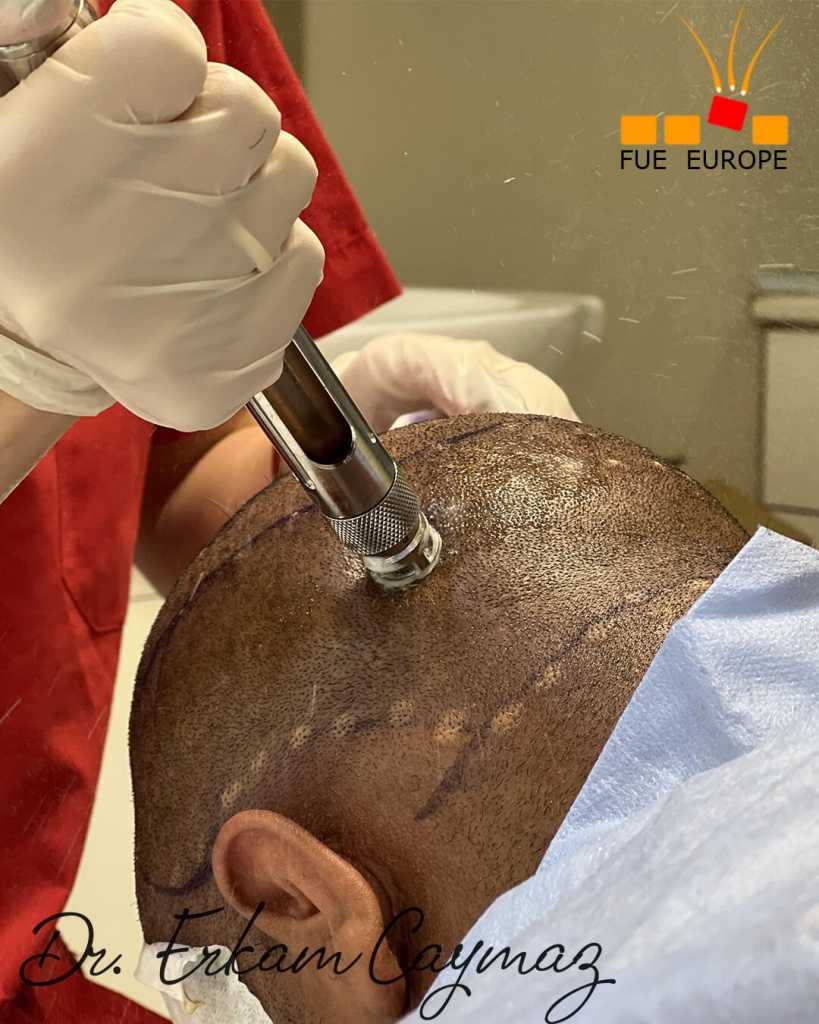
- Channel opening. Dr. Erkam performs the crucial step of opening the recipient sites himself using a sapphire blade in Sapphire FUE cases. This direct involvement allows him to precisely control the angle, direction, and depth of each incision. In female cases, the frontal hairline must exit at a much shallower, more acute angle than in men, ensuring the transplanted hair lies flat, soft, and flows naturally. For selected cases requiring finer control or an unshaven approach, DHI (Choi pen implantation) is utilised; it’s Sapphire FUE and DHI are distinct techniques, not a combined product.
- Graft placement. The finest single-hair follicular units are carefully selected and placed in the first one or two rows of the hairline. Two- and three-hair grafts are then strategically positioned behind them. This feathered, gradual transition is essential for preventing the abrupt, “wall of hair” masculine appearance and creating a soft, natural density.
Feminine vs masculine hairline: what actually differs
The distinction between a feminine and a masculine hairline is rooted in anatomical and aesthetic principles, not merely stylistic preference. Understanding these differences is key to evaluating any clinic’s before-and-after photos and ensuring your desired outcome.
| Feature | Feminine hairline design | Masculine pattern (to avoid recreating) |
|---|---|---|
| Overall contour | Rounded, oval, smoothly curved, soft | Flatter front with sharper, square corners |
| Temporal points | Preserved or restored, small and defined | Recessed, creating a prominent M-shape |
| Mid-frontal position | Typically 5.5–7 cm above the brow line | Often higher or distinctly receding |
| Frontal hair calibre | Finer single-hair grafts in the first rows | Coarser, denser leading edge may be acceptable |
| Transition zone | Gradual, feathered, 2–3 irregular rows | Sharper, more linear edge, less natural |
| Exit angle | Shallow, hair lies flat and forward | Steeper angle, hair may stand up more |
These principles are applied meticulously to correct recession, lower a naturally high hairline, or refine a previous transplant performed elsewhere that resulted in an overly heavy or unnatural look.
Risks, limits and realistic outcomes
Hairline transplantation in women is a safe and well-established procedure, but it does have limits that are important to discuss openly. Shock loss, the temporary shedding of existing hairs after surgery, is a genuine concern in female cases because the frontal band of native hair is often still present. While it usually recovers within 3 to 4 months, it’s important to understand that your hair might appear thinner before the new growth begins. Overall success rates for hair transplantation typically range from 90–95%, with graft survival rates reaching up to 98% when harvesting and placement are executed with precision. No reputable clinic can honestly promise a strong success rate, and you should be wary of any that do.
Other considerations include minimal scarring in the donor area (though FUE minimises this significantly, it’s not zero), temporary numbness around the hairline, and the possibility that progressive female pattern hair loss continues behind the transplanted area. This might necessitate future sessions or ongoing medical treatment to maintain density. This is precisely why an individual assessment, including blood work where indicated, is conducted before any surgical plan is finalised.
Non-surgical solutions for female hair loss
While surgery offers the most dramatic and permanent solution for hairline recession, it’s not the only option for women experiencing hair loss. Non-surgical treatments can play a vital role, either as standalone therapies or in combination with a transplant:
- Minoxidil (topical): Available over-the-counter, minoxidil can help stimulate hair growth and slow down hair loss in some women, particularly those with diffuse thinning.
- Oral medications: Certain oral medications, such as spironolactone or finasteride (off-label for women post-menopause), may be prescribed to address hormonal causes of hair loss.
- Platelet-Rich Plasma (PRP) therapy: As discussed in our PRP treatment for hair loss guide, PRP involves injecting concentrated growth factors from your own blood into the scalp. It can stimulate dormant follicles, improve hair thickness, and support the health of existing hair, often used to complement transplant surgery.
These non-surgical approaches are typically recommended for diffuse thinning or to stabilise existing hair loss. However, they generally cannot create a new hairline or significantly lower an existing one, which is where a meticulously planned hair transplant becomes the most effective solution.
Aftercare timeline
Recovery after a women’s hairline transplant is generally straightforward, but the first two weeks require careful adherence to post-operative instructions.
- Days 1–3: Rest is paramount. Patients should sleep in a semi-upright position and spray the transplanted area with the provided solution as instructed. Avoid touching or washing the grafts.
- Days 4–10: The first gentle washes are typically performed at the clinic or demonstrated thoroughly. Scabs will gradually begin to clear, and it’s crucial to avoid picking or scratching.
- Weeks 2–4: Most patients feel comfortable returning to work and resuming normal social activities. The recipient area may still appear pink, and some temporary shedding (shock loss) of existing hairs may begin.
- Months 1–3: Shock loss continues, and it’s common to see a temporary thinning of both transplanted and existing hairs. This is a normal part of the process. New, fine hair growth typically begins towards the end of this period.
- Months 4–6: Significant new growth becomes visible, and the hair begins to thicken. You’ll start to see the outline of your new hairline becoming more defined.
- Months 6–12: Hair continues to grow and mature, gaining density and natural texture. The final aesthetic qualities of the hairline become much clearer.
- Months 12–18: The final results are typically evident, with full maturation of the transplanted hair.
Frequently Asked Questions about Female Hairline Design
We understand you may have more questions about female hairline transplantation. Here are some common inquiries patients have at Hair Upload Clinic:
- How long does a female hairline transplant last?
- The transplanted hair is permanent. It is taken from areas of your scalp that are genetically resistant to balding, so it will continue to grow naturally for life. However, any existing non-transplanted hair may still be subject to ongoing hair loss if the underlying condition is progressive.
- Will my new hairline look natural?
- Absolutely. Dr. Erkam’s meticulous planning focuses on creating a soft, rounded, and age-appropriate hairline using single-hair grafts at the front. The goal is a result so natural that it’s undetectable as a transplant.
- Can I get a transplant if I have diffuse thinning?
- It depends on the cause and stability of your diffuse thinning. If your donor area is weak or the thinning is still active, a transplant may not be suitable. A thorough consultation with Dr. Erkam is essential to determine if you’re a candidate or if non-surgical treatments are more appropriate.
- Is the procedure painful?
- The procedure is performed under local anaesthesia, so you won’t feel pain during the surgery itself. You might experience some mild discomfort or soreness in the days following, which can be managed with prescribed pain relief.
- How much does a female hairline transplant cost?
- The cost varies depending on the number of grafts required and the complexity of the design. At Hair Upload Clinic, our pricing is competitive for a premium, surgeon-led experience in Istanbul, typically ranging from 2–4 Euro per graft. A detailed quote is provided after your personal consultation with Dr. Erkam.
Medical Disclaimer
This content is for informational purposes only and does not constitute medical advice. Always consult with a qualified healthcare professional for diagnosis and treatment of any medical condition.
Sources
- Current concepts in female pattern hair loss: A review (PubMed)
- International Society of Hair Restoration Surgery (ISHRS) – Hair Transplant Facts
- American Academy of Dermatology Association (AAD) – Hair Loss in Women
Conclusion: Your Feminine Hairline Journey with Hair Upload Clinic
Achieving a naturally feminine hairline through transplantation requires a blend of artistic vision and surgical precision. At Hair Upload Clinic in Istanbul, Dr. Erkam specialises in female hairline design, meticulously planning every detail from the delicate curves of the frontal line to the subtle presence of temporal points. We understand the profound impact a well-framed face can have on a woman’s confidence and overall well-being. By focusing on individual needs, utilising advanced Sapphire FUE and DHI techniques, and ensuring a boutique, surgeon-led experience, we are dedicated to delivering results that are natural and deeply harmonise with your unique facial features. If you’re considering a female hairline transplant, we invite you to schedule a consultation with Dr. Erkam to explore how we can help you achieve your aesthetic goals.
Clinic insight: At Hair Upload Clinic (HUC), Dr. Erkam reviews donor reserve, hair calibre, and long-term hair-loss pattern before recommending FUE or DHI: the goal is a natural hairline, not maximum graft count in one session.
Frequently Asked Questions
How long is recovery for this topic: Hairline design for women: framing the face without a mascul?
Most patients return to desk work within a few days, but graft protection rules apply for the first 10–14 days.
Is local anaesthesia used at Hair Upload Clinic?
Yes. Procedures are performed under local anaesthesia; sedation is not promoted for routine hair transplant surgery.
Can Dr. Erkam assess my case before I travel?
Yes. International patients can share photos and medical history for a preliminary graft estimate before booking Istanbul dates.
What affects graft survival after surgery?
Donor quality, implant technique, aftercare, smoking, and following the clinic wash protocol all influence early graft retention.
Sources: ISHRS: International Society of Hair Restoration Surgery; American Academy of Dermatology: hair loss; PubMed: follicular unit extraction review; PubMed: hair restoration surgery outcomes.
Medical disclaimer: This page is for education only and does not replace a consultation with Dr. Erkam at Hair Upload Clinic (HUC). Individual assessment is required.
Written by : Priya Sharma